
How an Original Treatment Concept Solves Industry Challenges in Industrial Wastewater Management
Strategic Importance of Integrated Industrial Wastewater Treatment
Industrial production is undergoing structural transformation. Increasing regulatory pressure, water scarcity in industrial regions, rising disposal costs and ESG-driven sustainability targets are fundamentally reshaping industrial wastewater management.
Across Europe and globally, discharge limits for COD (chemical oxygen demand), BOD (biological oxygen demand), AOX, PFAS (polyfluoroalkyl substances), heavy metals, Total-N, ammonium-N, sulphate and phosphorus are tightening. Simultaneously, the cost of disposing highly polluted waste water, concentrated residues and sludge continue to rise. In parallel, industrial sectors—from metal finishing and chemical processing to food production and pharmaceuticals—face increasing pressure to reduce freshwater withdrawal and achieve circular water strategies.
Traditional single-technology approaches are no longer sufficient.
What industry requires today is an integrated, robust and energy-optimized treatment design capable of transforming polluted water from a liability into a recoverable resource.
This is where a proven treatment approach can make the difference, helping companies reduce costs, meet discharge limits and recover water—guided by a reliable partner like KMU Loft Cleanwater (KLC).
The Core Industrial Challenge
Industrial wastewater is rarely homogeneous. It typically contains:
- Suspended solids and sedimentation-relevant particles
- Emulsified oils and fats
- Heavy metals (e.g., nickel, zinc, cadmium from galvanic processes)
- High COD/BOD loads and refractory organics
- AOX and complex industrial chemicals (e.g. PFAS)
- Ions as sulphates, phosphates, halogenides
- Organic and ammonium nitrogen
- Different salts that accumulate in recirculation systems
Conventional treatment systems—whether purely biological, membrane-based (RO/UF) or purely chemical-physical—often struggle with:
- Membrane fouling and concentrate generation
- Sludge overproduction
- High energy consumption
- High chemical consumption
- Instability under variable loads
- Increasing disposal costs
- Limited water recovery rates
- High space requirement
Moreover, concentrate streams from reverse osmosis or chemical treatment create secondary waste problems rather than eliminating them.
The key industrial opportunity lies in integrating technologies into a holistic, Zero Liquid Discharge (ZLD) framework.
Technical & Scientific Explanation of the Original Treatment Concept proposed by KLC
1. Multi-Barrier Engineering Approach
The concept is based on a structured, modular treatment philosophy:
- Mechanical and targeted chemical pre-treatment
- Advanced separation technologies
- Thermal concentration using advanced MVR (Mechanical Vapor Recompression) vacuum evaporation technology
- Optional crystallization/drying for complete ZLD implementation
This cascading approach ensures each pollutant class is treated using the most physically and chemically appropriate mechanism.
2. Chemical-Physical Optimization
The first stage addresses:
- Phase separation
- Sedimentation and suspended solids removal
- Precipitation of heavy metals
- Flocculation and filtration
Using controlled pH adjustment, coagulant dosing, and optimized hydrodynamics, dissolved metal ions are converted into insoluble salts.
Proper design minimizes sludge generation and ensures compliance with regulatory discharge limits.
Compared to standalone chemical wastewater treatment, the concept integrates precise automation and upstream pollutant profiling to reduce reagent consumption and stabilize process performance.
3. Membrane Technologies as Selective Tools
Ultrafiltration and reverse osmosis (RO) can be deployed for polishing and water reuse. However, membranes inevitably generate concentrates and are used in industrial wastewater just in cases the initial load is low enough for preventing scaling, fouling, or prohibitive pressures.
Rather than treating RO concentrate as waste, KLC proprietary concept integrates it into the next critical stage:
4. Evaporation with MVR advanced evaporation technology
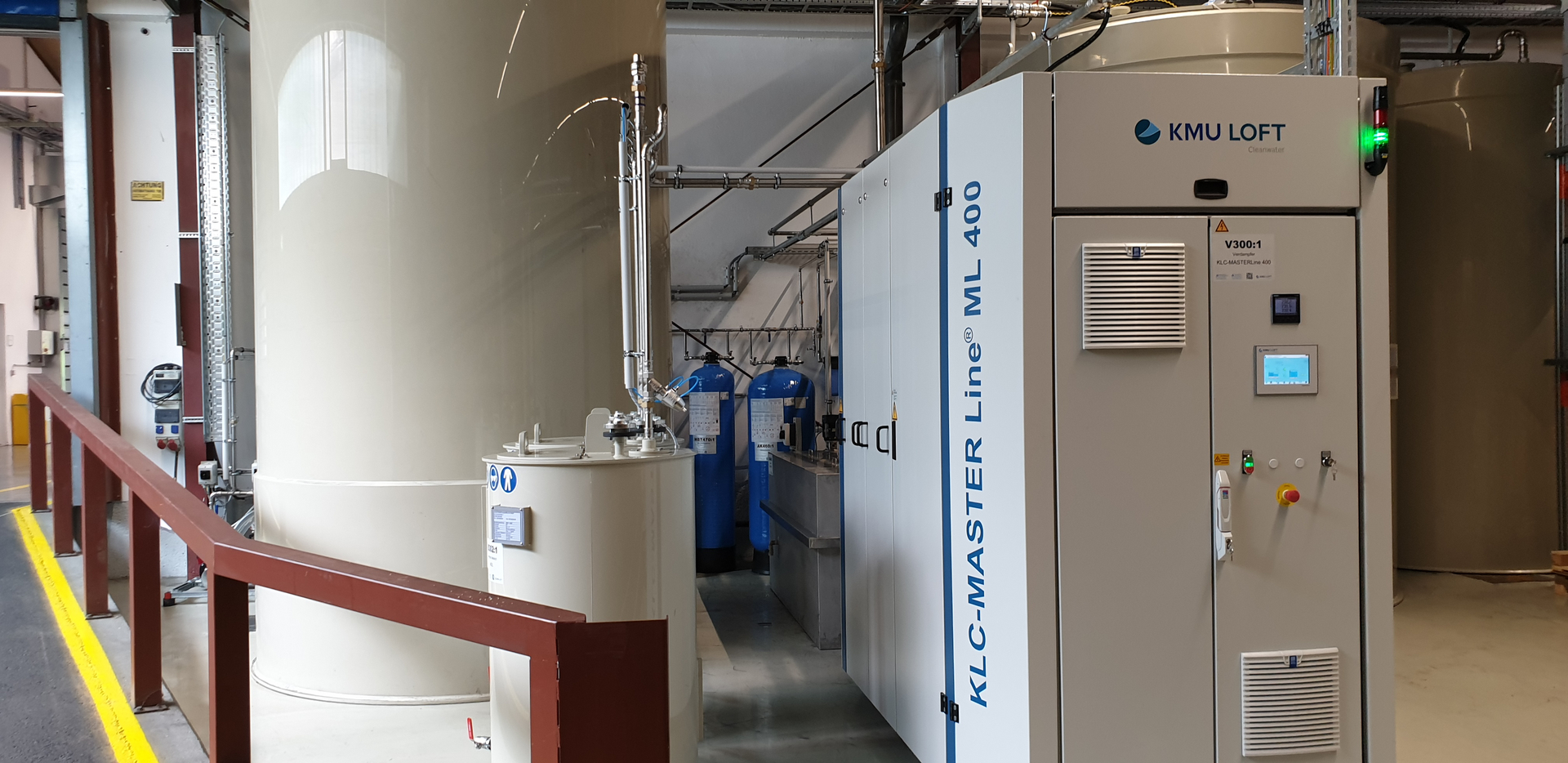
The technological core of the concept lies in advanced vacuum evaporation using Mechanical Vapor Recompression (MVR) technology.
Engineering Principle:
Heat recovery preheats the feed water.
Low vacuum lowers water’s boiling point.
Water evaporates at reduced temperature.
Vapor is mechanically compressed.
Compression raises vapor pressure and temperature.
Vapor latent heat is recovered to boil more water.
Condensation yields distilled water and recovers heat.
Maximized heat recovery: up to 90 % energy recovery.
Minimized energy demand compared to conventional thermal evaporation.
This approach achieves:
- High concentration factors
- Significant volume reduction
- Distillate recovery suitable for reuse as process water
- The lowest energy consumption of all evaporation technologies
- Preparation for Zero Liquid Discharge (ZLD)
Compared to energy-intensive thermal systems, MVR evaporation technology drastically reduces specific energy consumption per cubic meter treated.
5. Zero Liquid Discharge (ZLD) Capability
For industries requiring complete water reuse or discharge elimination, the final stage includes:
- Further concentration
- Crystallization
- Solid residue management
Zero Liquid Discharge (ZLD) is no longer a theoretical sustainability concept. It is becoming an operational necessity in water-stressed regions and highly regulated industrial sectors.
KLC proprietary treatment concept is engineered to be ZLD-ready, enabling:
- Maximum water recovery
- Minimum waste volume
- Regulatory security
- Long-term cost stability
Industrial Applications
The integrated concept is particularly effective in process water from:
- Metal finishing and galvanic industry (heavy metals as nickel, zinc, iron)
- Metal parts production (Emulsions, oils, COD, penetrating agents from crack detecting)
- Chemical industry (COD, surfactants, inks)
- Die casting (release and mould cleaning agents, glycols)
- Pharmaceutical production (high COD, micropollutants, API)
- Metal heating treatments
- Food and beverage wastewater (organic load, fats, proteins)
- Paint and metal coating industry
- High-salinity industrial streams (RO concentrates)
- Nuclear plants (radioactive components)
- Landfilling
By combining chemical physical treatment, filtration and evaporation technologies based on MVR evaporation into a unified architecture, the system adapts to fluctuating wastewater compositions typical in industrial production at the lowest energy consumption and footprint.
Strategic Implications for Industry
1. Cost Reduction
- Lower disposal costs through volume reduction
- Reduced freshwater procurement
- Lower energy consumption via MVR technology
2. Regulatory Compliance
- Reliable control of COD, AOX, heavy metals, sulphates, nitrates and other ions
- Alignment with evolving EU water directives
3. Sustainability & ESG Alignment
- CO₂ reduction through energy-efficient evaporation
- Circular industrial water recycling
- Measurable contribution to sustainable water management
4. Operational Security
- Modular scalability
- Stable operation under load fluctuations
- Reduced dependence on external wastewater disposal
Conclusion
Industrial wastewater treatment is no longer a peripheral environmental task—it is a strategic production factor.
A proprietary, integrated treatment concept that combines chemical-physical processes, filtration and MVR vacuum evaporation technology enables:
- High water recovery
- ZLD capability
- Reduced operating costs
- Long-term regulatory compliance
- Sustainable industrial water management
For industrial operators, the question is no longer whether to optimize wastewater treatment—but how to implement a future-proof system design.
If you are evaluating the modernization of your industrial wastewater treatment plant, planning a Zero Liquid Discharge system, or seeking to reduce disposal costs and freshwater dependency:
We invite you to connect with our Industry experts.
Request a technical consultation or follow us on (LinkedIn/web site) to receive in-depth insights on:
- MVR evaporation technology Applications
- ZLD system design
- Energy-efficient industrial water recycling
- Advanced treatment strategies for complex industrial effluents
KMU LOFT Cleanwater SE develops engineered solutions that transform wastewater challenges into measurable operational advantages.