

What Is Industrial Wastewater and Why Is It Fundamentally Different from Municipal Wastewater?
Introduction: The Strategic Importance of Wastewater Differentiation
Water scarcity, tightening discharge regulations, ESG reporting obligations and increasing water reuse targets are reshaping industrial operations worldwide. In this context, understanding the difference between industrial wastewater and municipal wastewater is not a semantic exercise but a strategic necessity.
While both streams are categorized as wastewater, their chemical composition, variability, environmental risk, treatment requirements and economic implications differ profoundly. Confusing the two leads to under-designed treatment systems, compliance risks and significant operational costs.
For engineers and plant managers, the distinction defines technology selection, CAPEX planning, discharge permitting and long-term sustainability strategies.
The Core Industrial Challenge
Municipal Wastewater: Predictable and Biodegradable
Municipal wastewater—also referred to as domestic sewage—originates primarily from households, commercial buildings and public facilities. It typically contains:
- Biodegradable organic matter (BOD, COD)
- Suspended solids
- Nutrients (nitrogen and phosphorus)
- Pathogens
- Household detergents and minor chemical residues
Its composition is relatively stable and largely biodegradable. As a result, conventional biological wastewater treatment processes—activated sludge, trickling filters, membrane bioreactors—are highly effective.
Industrial Wastewater: Complex, Variable and Process-Dependent
In contrast, industrial wastewater is generated directly from manufacturing and process operations. Its composition depends entirely on the industrial sector:
- Heavy metals (electroplating, mining)
- High salinity brines (chemical industry, surface treatment)
- Oil and hydrocarbons (petrochemical, metalworking)
- Toxic organics and solvents (pharmaceutical, fine chemicals)
- High-temperature streams
- Extreme pH values
- Non-biodegradable compounds
- High Total Dissolved Solids (TDS)
Unlike municipal wastewater, industrial effluent is often:
- Highly variable in flow and composition
- Non-biodegradable
- Toxic to biological treatment systems
- Concentrated in salts or specific contaminants
This complexity fundamentally changes the treatment paradigm.
Technical Insights into Wastewater Treatment for Cost Reduction and Water Reuse
1. Composition and Load Differences
Municipal wastewater is typically characterized by:
- Moderate COD/BOD (primarily biodegradable)
- Low to moderate salinity
- Narrow pH range (6.5–8.5)
- Consistent daily load patterns
Industrial wastewater may present:
- Extremely high COD/BOD (often non-biodegradable)
- TDS concentrations exceeding tens of thousands of mg/L
- High concentrations of specific ions (e.g. chlorides, sulphates)
- Heavy metal contamination
- Emulsified oils
- Recalcitrant organic compounds
The COD/BOD ratio is useful in scenarios where COD is significantly higher, particularly for assessing treatment efficiency. In contrast, the biodegradability index (BOD/COD ratio) is commonly used as an indicator of biodegradability. In industrial effluents this ratio is often lower, highlighting their limited suitability for biological treatment.
2. Treatment Technologies: Biological vs. Physical-Chemical and Thermal Processes
Municipal treatment plants rely predominantly on:
- Primary clarification
- Biological oxidation
- Nutrient removal
- Secondary clarification
However, industrial wastewater treatment frequently requires advanced and multi-stage solutions:
- Chemical precipitation
- Coagulation/flocculation
- Membrane filtration (UF, NF, RO)
- Advanced oxidation processes (AOP)
- Ion exchange
- Vacuum evaporation
- Crystallization systems
- Zero Liquid Discharge (ZLD) systems (combination of the above-mentioned processes)
Why Biological Treatment Is Often Insufficient
Industrial effluents with:
- High salinity
- Toxic substances
- Solvent residues
- Fluctuating loads
can inhibit or destroy biological microorganisms, making conventional municipal treatment technologies ineffective.
3. The Role of Vacuum and MVR Evaporation in Industrial Wastewater Management
In high-salinity or complex industrial streams, vacuum evaporation becomes a technically robust solution.
Engineering Principle
Vacuum evaporation operates under reduced pressure in the evaporation chamber, which consequently lowers the boiling point of water. In particular on MVR (Mechanical Vapour Recompression) technology, the generated vapour from boiling water is then mechanically compressed to a higher pressure and temperature and reused as a heating medium, thereby enhancing both energy transfer and heat recovery.
This enables:
- Efficient separation of water from dissolved solids and organic heavy pollutants
- Concentration of the contaminants in the concentrate stream
- Recovery of high-quality distillate
- Volume reduction of hazardous waste
all by the most optimal energy efficiency reached in an evaporation process.
Key process parameters include:
- Operating pressure
- Heat transfer surface area
- Temperature control
- Anti-scaling management
When integrated into Zero Liquid Discharge (ZLD) systems, MVR vacuum evaporators allow:
- Maximum water recovery
- Minimal discharge
- Energy efficiency maximization
- Salt crystallization in second step
- Compliance with strict environmental regulations
This approach is rarely necessary for municipal wastewater, but often critical for industrial applications.
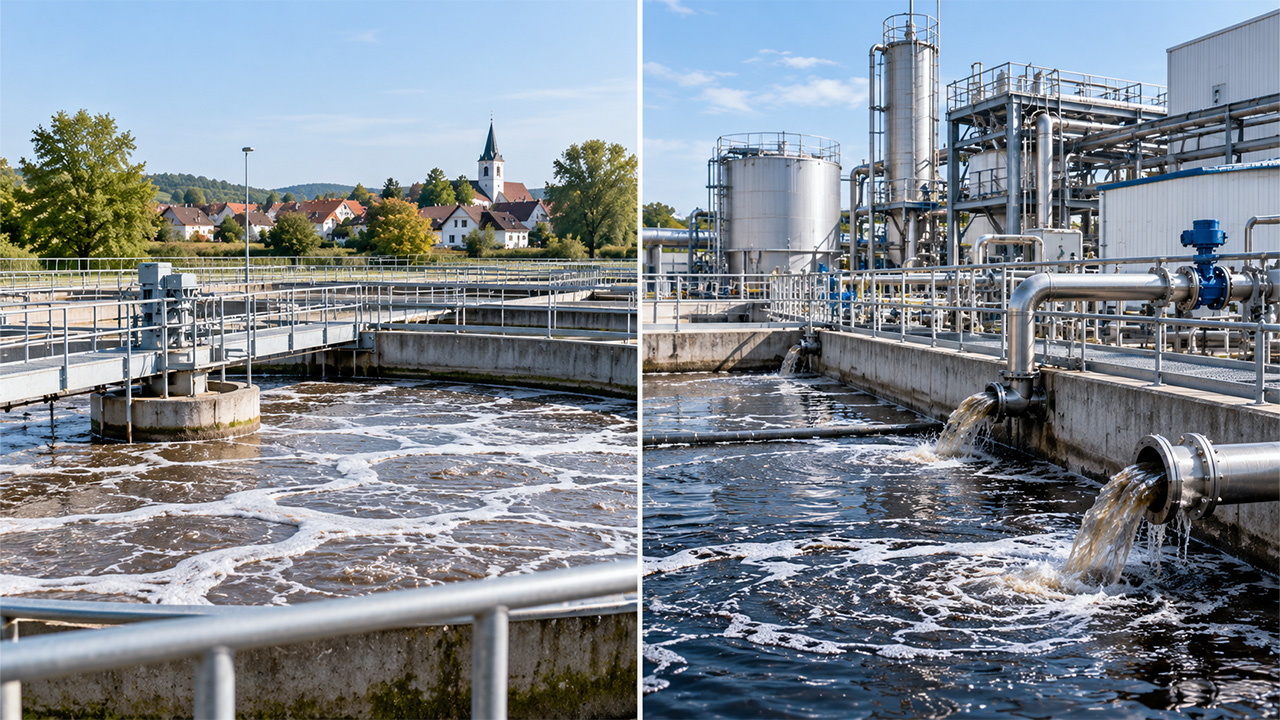
Industrial Application Example
Consider a metal surface treatment facility:
- Rinse water contains heavy metals and high TDS.
- Discharge limits for zinc, nickel or chromium are strict.
- Direct discharge to municipal treatment may be prohibited.
A conventional biological system would fail.
Instead, the plant may implement:
- Chemical precipitation for metal removal
- Filtration for solids separation
- MVR evaporation for brine concentration
- Optional crystallization for solid salt management
The result:
- Significant reduction in wastewater volume
- Water reuse within the production cycle
- Compliance with environmental regulations
- Minimum energy consumption possible
- Lower long-term disposal costs
Strategic Implications for Industry
Understanding the distinction between industrial and municipal wastewater directly impacts:
1. Regulatory Compliance
Industrial discharge permits are often sector-specific and significantly stricter.
2. Operational Risk
Misclassification of wastewater can result in:
- Treatment failure
- Fines and shutdowns
- Environmental liabilities
3. Economic Optimization
Advanced treatment solutions—especially MVR evaporation processes—enable:
- Water reuse
- Reduced freshwater dependency
- Minimized disposal volumes
- Long-term cost savings
- Minimal energy consumption
4. ESG and Sustainability Targets
Industrial water management is now a board-level issue.
Zero Liquid Discharge strategies and wastewater minimization are key components of sustainable production.
Conclusion
Industrial wastewater is not simply “dirtier” municipal wastewater. It is fundamentally different in:
- Composition
- Variability
- Toxicity
- Salinity
- Treatment requirements
- Strategic impact
While municipal wastewater can be managed primarily through biological processes, industrial effluent often demands advanced physical-chemical and thermal technologies—especially when pursuing water reuse, wastewater minimization or Zero Liquid Discharge (ZLD) and consequently a cost reduction.
For modern manufacturing facilities, understanding this distinction is the foundation of effective, compliant and sustainable industrial water management.
If you are evaluating how your facility’s wastewater profile impacts treatment strategy, regulatory compliance, or water reuse potential, a detailed technical assessment is the logical next step.
Subscribe to our technical newsletter for in-depth engineering insights on:
- MVR evaporation systems
- Zero Liquid Discharge design strategies
- Industrial wastewater optimization
- Regulatory-driven process adaptation
Or request a consultation with our technical experts to analyze your specific industrial effluent profile and identify scalable, energy-efficient treatment solutions.